
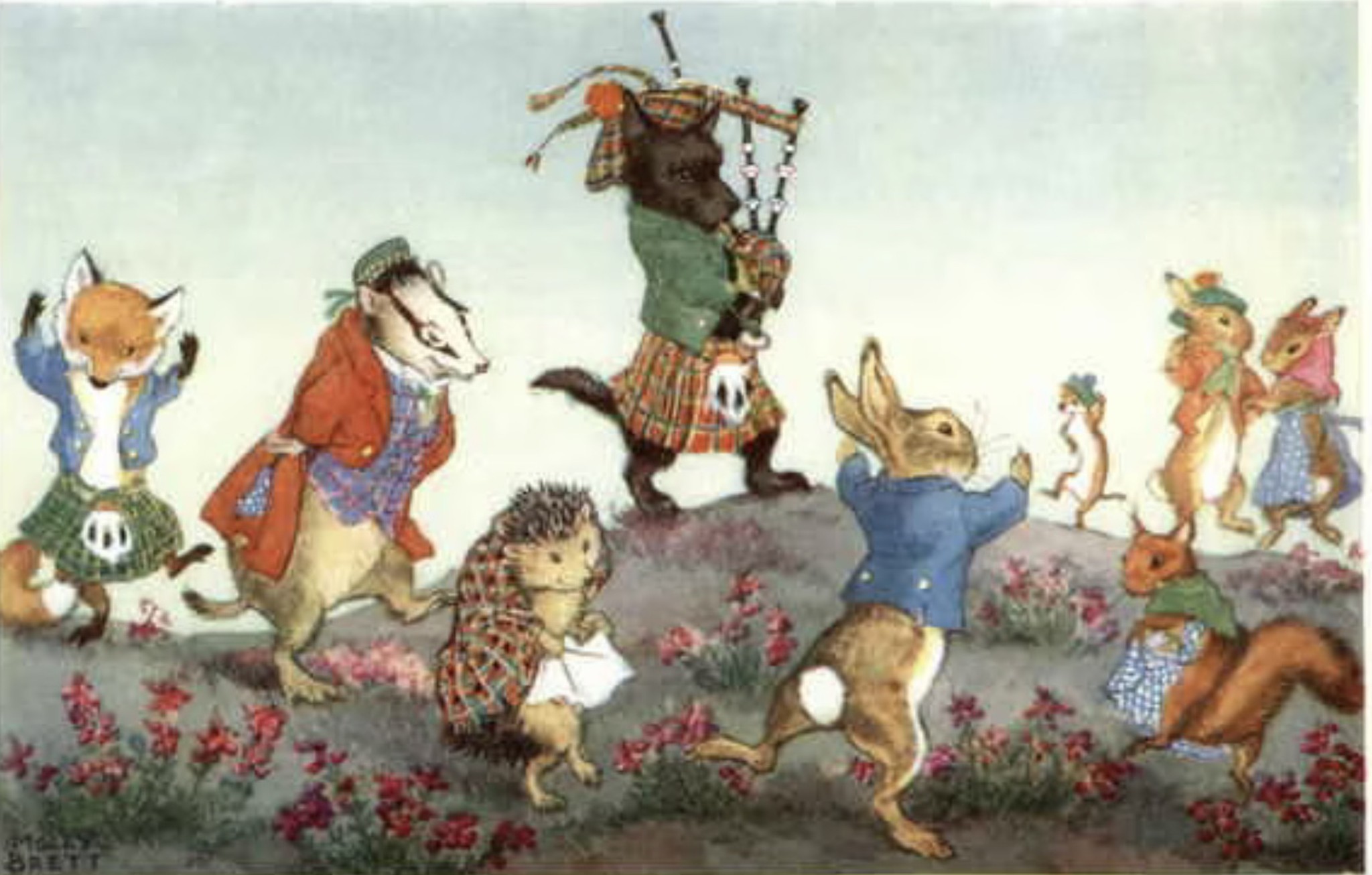
Our first New Year’s Ceilidh for Parents who love the Traditional Latin Mass (and their Bairns) took place yesterday afternoon in Ravelston. It was for many an all-afternoon event: Noon Mass at St. Andrew’s, then lunch during After-Mass Coffee Hour, and finally the dancing around the corner and down the street.
When I arrived at church, I had no idea how many families were coming: the louder-than-usual children’s noise during Mass was music to my ears. And when I saw the crowd outside afterwards, I rushed to the kitchen to help the new Head Tea Lady. It was undoubtedly a 3+-jumbo-pot-of-coffee situation.
There was one moment of fear—the janitor did not arrive to open the Dean Hall door until we telephoned him—but then after that, everything was fine. Our wonderful band, our ceilidh teacher, our volunteers (self-selected from the regulars), and nine families arrived. The children never stopped moving, so I lost count of family members at 42. I think that all together we were about 50.
Sophia and I had two planning sessions for the event, but we both knew that simplicity and flexibility would be key. I worked out how to dance the Branle de l’official as easily as possible–the Baby Brantle, as it were. Sophia planned to teach the Gay Gordons, the Flying Scotsman, the Dashing White Sergeant, the Virginia Reel, and the Military Two-Step but, as the dance progressed, dropped the latter two and added the Canadian Barn Dance instead.
I was freed from the eternal quest for gender parity, for we simply spoke in terms of “leads” and “follows”. The lead was simply the partner who was physically stronger. This in general meant that parents were leads, children were follows, and the remaining children worked out their roles among themselves. That said, in some cases, fathers were leads, mothers were follows, and they danced carrying their babies. It was all delightful.
We began, as always, with the Welcome Address and the Prayer to St. Michael, and then I explained the history of the 16th century Branle de l’official, to whose music “Ding Dong Merrily On High” was set in the 1920s. I then showed it according to the simplest steps, which logically follow the parts of the tune (and carol). Before the Gloria, four steps to the left, four steps to the right, repeat left, repeat right. For the Gloria, twelve steps to the left. Then (pièce de résistance) for “Hosanna in excelsis“, partners face each other, kick left foot, kick right foot, and the follow jumps in the air, supported by the lead. The assisted jumping, so beloved of the Elizabethans, I thought would find favour with the little ones. Indeed it did, and their fathers practically threw them in the air. And naturally we sang the carol first, all holding hands, and then danced it three times. It was a wonderful way to begin, so merci beaucoup, Monsieur l’abbé.
There followed the ceilidh dances, explained in their simplest forms, with waltzing steps dropped for simple turns holding hands. The Flying Scotsman derailed multiple times but no casualties were reported.
Between dances there were raids upon the refreshments table, and I was very grateful to everyone who brought cakes and biscuits and crisps, for the five dozen cookies I baked would not have sufficed. Incidentally, whenever children and cake collide, there are crumbs, and next time I will bring a broom.
There was unprecedented merriment. I mean, the 20- and 30-somethings have fun, but not to the extent children have fun. Apart from the babes in arms and one or two conscientious objectors, the children took to dancing like ducklings to water. They danced joyfully, wholeheartedly and inexhaustibly. When we called an intermission so that they (and the band) could rest and the swing-dancers could show their stuff, the children kept on dancing.
Some parents danced then, too, which was very moving, actually. One of the jazz tunes was bluesy, and a couple who had met through swing lessons danced the blues, the father holding their daughter as they danced. (Amusingly, another girl came along and, as the blond moppet looked at her over her father’s shoulder, handed her a cookie.) What a delightful coincidence that the TLM Gospel that day described the Wedding at Cana. Married people with children absolutely should dance together, but when do they usually get the chance?
After the intermission, we danced the Baby Brantle again, and then the Gay Gordons, the Canadian Barn Dance, and–very slowly and carefully–Strip the Willow. There followed the singing of Alma Redemptoris Mater and “Auld Lang Syne.”
On went the jazz again, but I don’t recall if anyone danced, for I went to the kitchen with the donations box to count the money and put it in an envelope for the band. The band had generously volunteered, but I absolutely did not want them to go home empty-handed, and thus I put a little more emphasis on donations in the advertising.
Ending a little early was a good idea on Sophia’s part, for it gave the parents and children time to gather themselves together, exchange last remarks with friends and, apparently, practise playing football with squashed paper cups. I heard some wonderful comments from parents–and even received honest thanks from children–about the ceilidh that will keep my heart light as I return to the workaday world. I was particularly struck by a father’s joy in seeing so many families together and the happiness on the children’s faces.
This to me is how a community should celebrate Christmas (which doesn’t end until Candlemas, of course) and the New Year. And I am reminded yet again of Michael Platt’s description of traditional Western communal dancing:
In all dancing, the dancers move to the same music; mere individuals are formed into a community. But there are so many ways of arranging a community — or not. In all dancing in the West, at least since the Renaissance, the couple exists between the music and the individual; in all this dancing you have to co-ordinate yourself to your partner and, often enough, you and your partner have to coordinate yourselves to other couples (think of square dancing). The first points toward marriage, the second toward a village.
A goodly part of our village had come together, and I am delighted to have been a part of that.
(Image “When Scottie Plays the Pipes”, postcard by Molly Brett, 1930s :The Medici Society)
Leave a Reply