
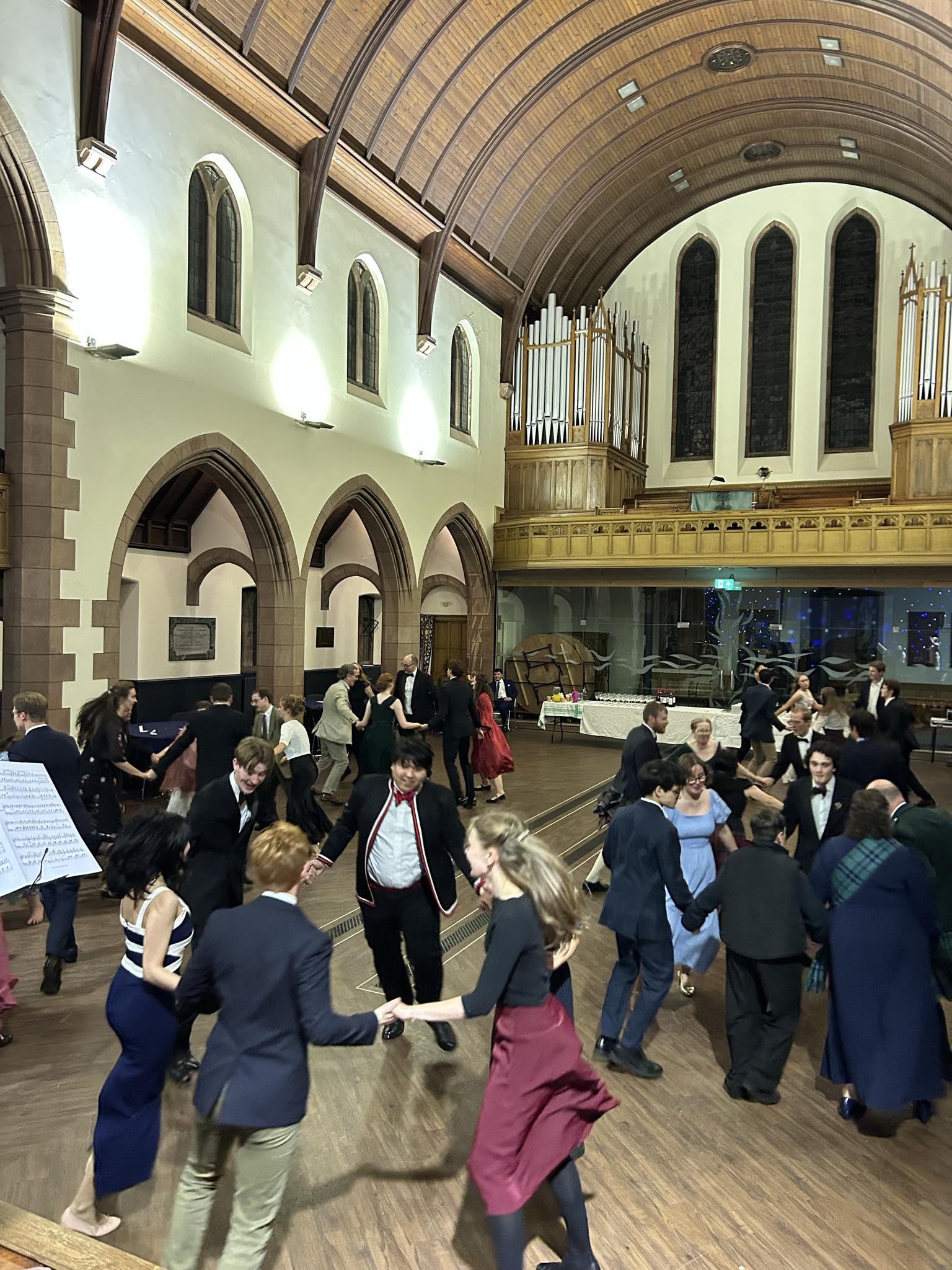
On Sunday someone told me how much she enjoys our dances for Catholics who love the Traditional Latin Mass (and our friends). She declared that they are unique, and I can think of several reasons why that might be.
First, they are the biggest social occasions (south of the Forth Bridge, north of the Border) for our minority-within-a-minority, Catholics in Scotland who worship God on Sundays according to the Old Rite. Some support the FSSP, some the SSPX, and others the diocesan provisions for TLMers in Glasgow and Dundee.
Second, they also include Catholics who are content with the Ordinary Form and go to Mass (the majority-within-the-minority) at their parish churches.
Third, they feature waltzes as well as ceilidh dances, and provision is made at the intermission for those who enjoy swing-dancing.
Fourth, they are blessed by musicians from the wider Catholic community in Scotland, who generously pour out their talents for their friends. There are also younger-than-usual callers who take turns calling the figures of the ceilidh dances.
Fifth, they are organised with dance cards. Time is allotted at the beginning of the evening for gentlemen (of all ages) to rush around with their cards to reserve dances with the ladies. Yes, we are indeed old school.
Sixth, they are multi-generational. The majority of people who come to the Michaelmas and Easter Friday dances are singles between 20 and 40. However, there is a notable contingent of married couples who company their teenagers and those younger children old enough to dance among giants. Usually a seminarian or priest turns up and accepts a piece of cake.
Seventh, they have an obvious hostess, Mrs McLean, i.e. me. My prime directive is hospitality: greeting guests, introducing guests to each other, dancing with gentlemen who haven’t secured partners, making sure food and drink are on the refreshments table, and bidding guests farewell at the end. I am the person to approach if someone can’t match a face to the name written on their card.
Eighth, they begin with a prayer to Saint Michael the Archangel and end with an anthem to Our Lady.
Ninth, they feature traditional food. That is to say, a very large carrot cake recalling ancient Michaelmas traditions in Scotland and Ireland. (This cake appears also at Eastertide, however, recalling—the Easter Bunny?) There is other home baking, too, and sometimes crisps and sausage rolls. This last greatly depends on the guests themselves.
Tenth, the dress code encourages smartness, national traditions, and modesty without being tyrannical. Most of the men wear suits and ties. All the women now wear long dresses or skirts. I disguise my own plunging charity-shop necklines with a tartan sash and host of tiny safety pins.
Eleventh, complimentary and optional workshops are held in advance of the big dances. Few people outside Austria are taught to waltz these days and not everyone grew up in Scotland, where ceilidh dancing is taught in primary school. Thus, those who want them can have lessons and practise beforehand, which makes for more confidence on the dance floor.
Twelfth, there is neither funding nor profit motive. Poor Mr McLean watches his wife reserve Edinburgh halls, pledge honoraria to musicians, ring up a hefty bill at Tesco and cajole all their Catholic friends and acquaintances to buy tickets. It is all a gamble. And for what?
For the magical three-and-a-half hours in which members of tradition-minded Catholic community who can* come together to pray and sing, chat and dance, play music or call figures, eat cake and drink squash (or wine). Together we are all making memories. It’s really something, and I hope you will join us this year.
*A perennial difficulty is finding babysitters when the preferred candidates are all at the dance. Thus, MMWP now sponsors Edinburgh afternoon dances for families. Our next will be in late October.