
If you have a Substack or blog devoted to Christian themes, I highly recommend writing something about Women’s Clothing from time to time. It will get viewers and viewer response like nothing else.
Why is this? I think it is because Women’s Clothing is a major battlefield in the war between How Things Are and How We Wish They Would Be, between Uncomfortable Truths and Easy Lies.
As Christians, we are, of course, on the side of Reality and Truth. The reality is that human beings are corporeal (we have bodies), sexual (we have binary roles in reproduction), and social (we must live together in communities, somehow or another).
Clothing pertains to all these realities of human existence. We have to wear clothing so we don’t roast or burn or freeze or get caught on thorns or stung by bees. We also have to wear clothing so that we don’t sexually arouse people. And finally we have to wear clothing because it is part of our (usually unspoken) social contract.
This sounds very shocking in this selfish age, but what I wear is not entirely up to me. In fact, my workplace has a dress code, and maybe yours does, too. My high school had a uniform. I once received a wedding invitation asking ladies to wear hats. Men and women are preventing from entering St. Peter’s Basilica for wearing shorts and tank tops. The American wedding industry says female guests should never, ever wear white. The Buckingham Palace garden party dress code stipulates: “Gentleman may wear morning coat, lounge suit or uniform (no medals). Ladies may wear day dress with hat/fascinators or uniform (no medals). Trouser suits may be worn.”
The social contract about clothing changes from place to place. In Edinburgh, women tend to cover their heads at the Traditional Latin Mass, but in France they do not. In Edinburgh, women rarely wear trousers to the TLM, but the wife of the French Consul often did. In Edinburgh, when I see a teenage girl wearing leggings to the TLM, I assume her family turned up unawares and make a private bet about whether or not they leave before the homily. Meanwhile, in summer I worry about sleeves. Will anyone be offended if I wear a dress without sleeves to Mass? Will anyone fall victim to my mature charms if I wear a dress without sleeves to Mass? It doesn’t seem likely, come on.
However, you never know. I think one reason many Catholic girls and women get annoyed by the idea our attire could lead men (willingly or unwillingly) to sinful thoughts is that we underrate our attractions. This is probably because we see dozens of images a day of “attractive women” who look nothing like us: slimmer, younger (or older), flawlessly skinned, silken haired.
There is also a basic unawareness that men don’t experience the world in the same way we do. According to Father Thomas Morrow, “Pope John Paul II, … in his book Love and Responsibility, concludes that, “The evolution of modesty in woman requires some initial insight into the male psychology.” They have physical disadvantages as well as advantages. It’s great that they can get lids off jars, but they can’t ignore our bodies as easily as we can ignore theirs.
Fr. Morrow also cites a Father Knight, who says something quite shocking, and perhaps insensitive to real rape survivors, but worth contemplation all the same:
In the measure that a particular style of dress is consciously and deliberately provocative — whether the deliberate intent is on the part of the designer, or the wearer, or of both—this way of dressing must be recognized as a mild form of reverse rape by which a person arouses unsolicited sexual desire on another person who may not want to be aroused. Whenever this happens to men (who are more subject to this kind of arousal than women) it always causes some anger, whether recognized or not. This may explain some of the hostility and aggressive behavior that men are guilty of toward women
Okay, yikes. Explain, not excuse. Explain, not excuse.
Realty and Truth can really be uncomfortable sometimes. And on that theme, I must say that the most uncomfortable email I ever received was from a young woman who had gone to a party dressed in very modest clothing, stood out like a sore thumb amongst the immodest girls, and was raped by a man who had told her he bet she would be too scared to be alone with someone like him. When it comes to sexual violence, what you are wearing is totally irrelevant. But when it comes to respecting decent men’s psychological limitations (or what we used to call “being a lady”), what you wear really does count.
This is just part of the social contract about clothing, but it is the one most obviously violated and, indeed, fought over in Christian circles. However, many women in the TLM community have made our peace by opting to express our identity as TLM-loving Catholics through wearing skirts that fall below our knees and bodices that entirely cover our breasts and (usually) shoulders.
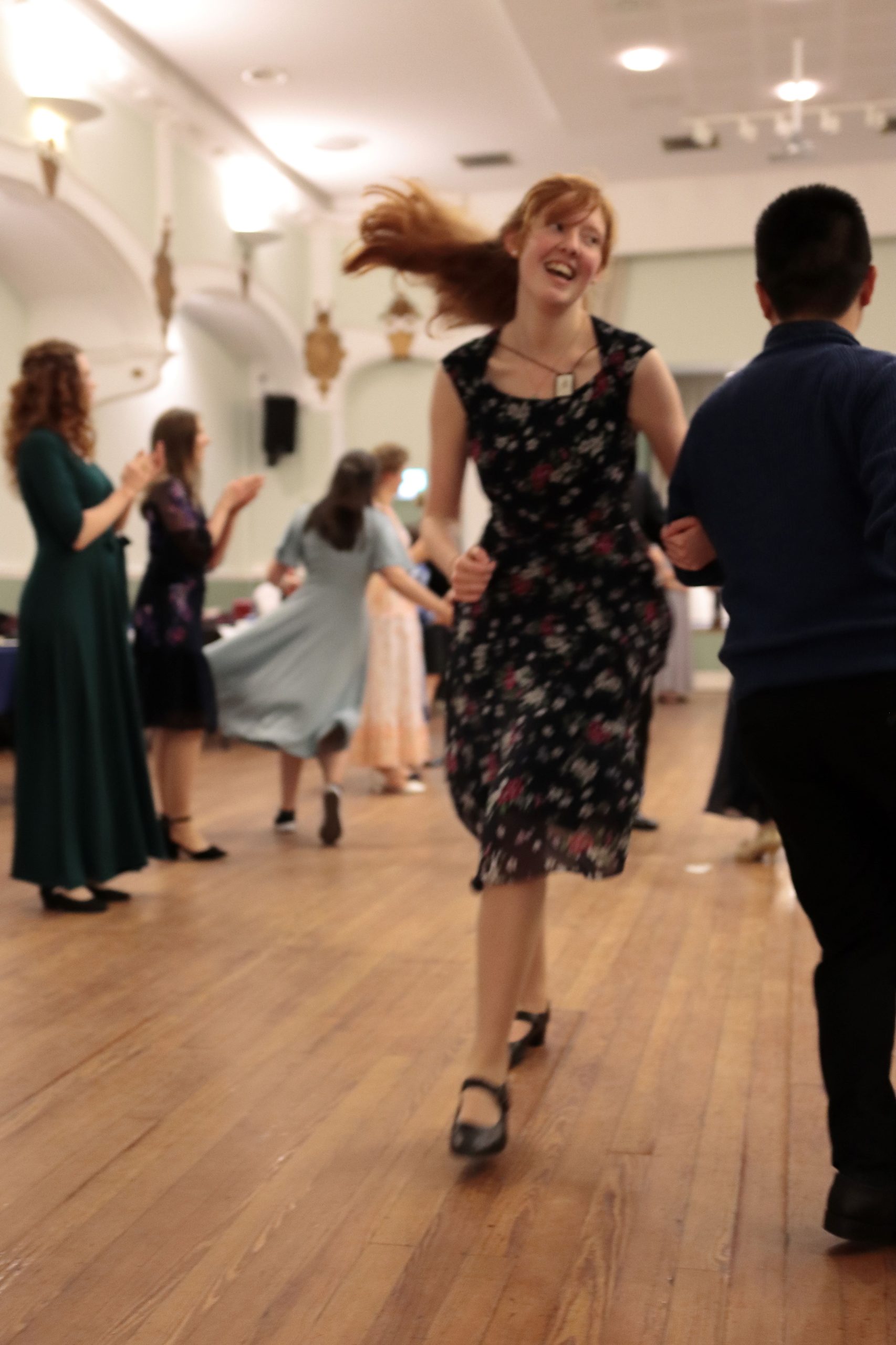
As it says on the tickets, the Michaelmas Dance is “black-tie optional”–which simply means wear your best clothes: the clothes you would wear to an evening wedding reception, perhaps. Gentlemen have the chance to wear dinner jackets, Highland dress, or other national dress. Ladies have the chance to wear our most elegant attire. Traditionally, this is a full-length dress, but not everyone has one, so a pretty hem-falling-below-the-knee skirt is perfectly acceptable. Sleeveless gowns are, too. However, plunging necklines definitely are not. In fact, please avoid a low neckline altogether. The point to the dress code is to show respect for St. Michael, the occasion, and each other.
My teenage self (a student at an all-girls school) would grumble inwardly about how I could meet boys if not allowed to get their attention with my sassy outfits. The answer to that–which would never have occurred to me–was that making introductions was not my job but that of my friends or hosts. How hard would it have been to ask another girl, “Please introduce me to your friends when we get to the dance?” And how hard would it have been for high school dance chaperones to think through the subject of introductions?
Happily, at big Mrs McLean’s Waltzing Party events, I do my best to make introductions (and I encourage others to do the same). Also, we have dance cards, so everyone does introduce themselves when the boys and men ask the girls and women for reservations. Thus, no sartorial tricks are needed (and, indeed, might backfire).
Leave a Reply