
My favourite hobby is not dancing but learning Polish. This comes in handy when I visit Poland or small Polish visitors turn up at my door brandishing storybooks. It is also the royal road to traditional Polish culture, which is almost unimaginably rich, as well as intertwined with the Christian—predominantly Catholic—faith.
Time travelling
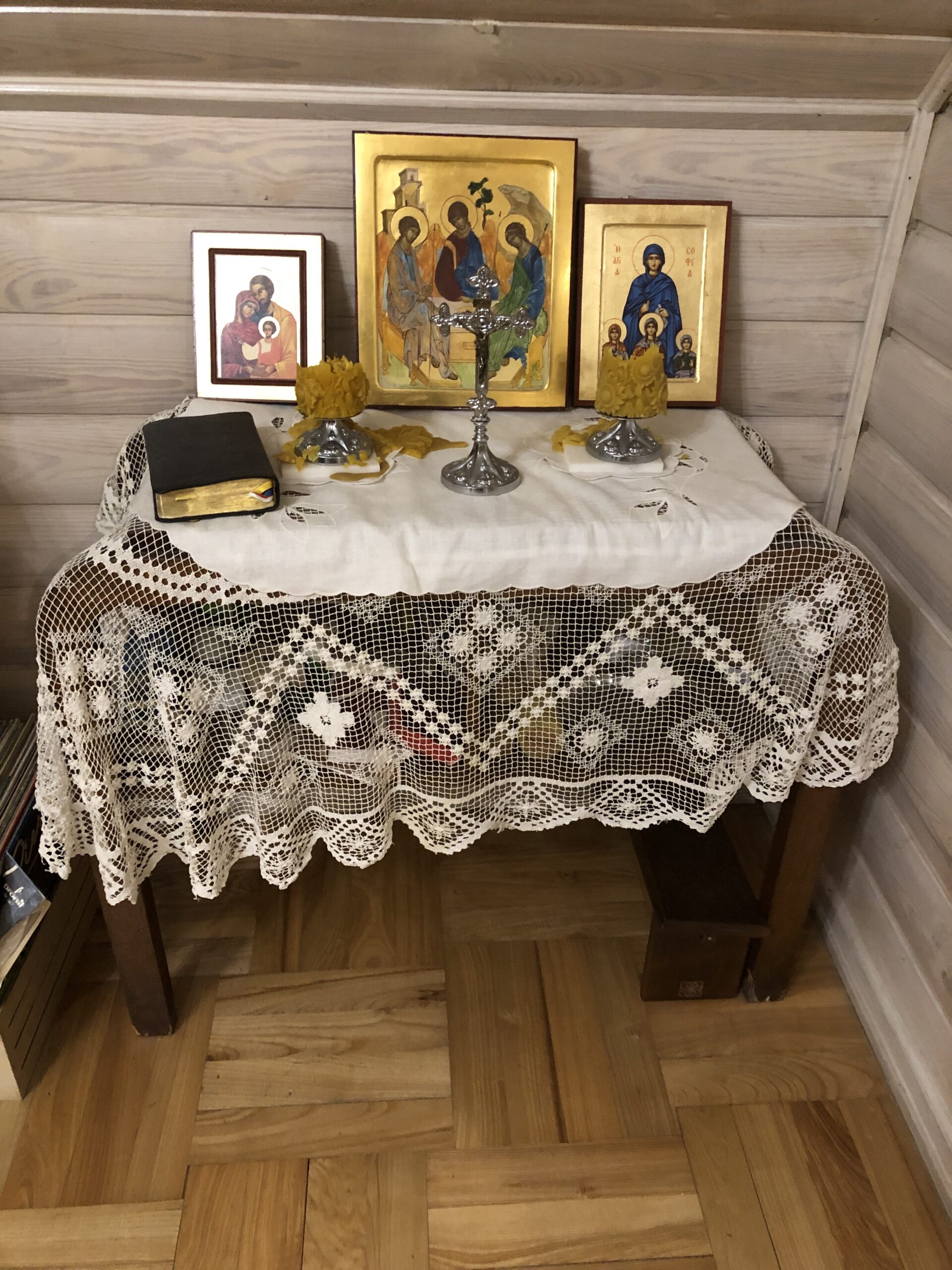
My best Polish friends are traditionalists, and when in Poland I spend moments in their company that are tantamount to time-travelling. On Thursday night, I joined a young mother and her two little children before the family altar for evening prayers. The walls were wooden, several icons reposed on the altar, and candles provided the only light. The mother led her girls through the Sign of the Cross and then began to sing the 13th century’s Bogurodzica (Mother of God). The hair stood up on the back of my neck.
It could have been 1925.. It could have been 1325. For a moment, I felt completely outside of time, a breath-length away from a Polish mother simultaneously praying and teaching her children to pray. How many millions of Poles have learned this hymn from their mothers, kneeling in candlelight, I wondered.
Partying like Pan Tadeusz
Most of the rest of my stay was more earthly and riotous, if not without strong traditional elements. My host’s family and friends and their children crowded into an eating house on Friday night, and enjoyed a picnic outside his half-renovated house in the countryside on Saturday afternoon, and roasted kielbasa over an open fire after Mass on Sunday. On Saturday night, as adults gathered around a word game, children slept under coats or listened to stories read by their Canadian-Scottish captive until they, too, fell asleep.
During the day, when a few of the adults left off eating and drinking to play violin, guitar and tambourine, some of the children danced. My hostess, who on Saturday had pressed me into tambourine service, broke off playing long enough to correct her little daughter’s steps. Folk dancing, like folk music, should be done according to the traditions; it is not a mere leaping about.
There was a magical moment, after dusk fell on Sunday night, when many of the assembled company all sang together, our host banging the tambourine, our hostess on the fiddle, an earnest young man simultaneously playing his guitar and reading the lyrics or music on his phone.
(There was a strangely political moment when,, as I was carrying dishes from the garden to the house, I encountered a large group of guests outside the side door. All the children, the eldest no older than 6, were chanting “ZŁO-DZIE-JE! ZŁO-DZIE-JE!” [Thieves, thieves!]
“It’s a manifestation [i.e. manifestacja, political demonstration],” one of the men explained.
Poles love protests; I assume this one was about taxation.)
Needless to say, Saturday and Sunday’s parties were held in the open air, and when on Saturday it rained, we merely took shelter in the brick-walled barn. The only surprising thing about my visit is that we did not, as previously planned, go mushroom-picking. (That said, a casual walk in the woods on Monday did turn up a few fungi, picked by a 5-year-old, who showed them to her mother. Polish children learn about mushrooms the way Canadian children learn to swim. Earlier, the 5-year-old and I had looked at a mushroom guide, and she had pointed out to me the edible and the poisonous.)
How all this relates to dancing
I have been trying to work out a relationship between these old-fashioned parties and the theme of this blog, and the most obvious answer is that my host and hostess met at a social dancing festival in Kraków. According to legend, my future host was larking about at a meal and in mild reproof my future hostess sang an old foxtrot tune (1933) about a would-be film star at him. He was charmed, and the results, to date, have included a wedding and two children.
A less obvious answer is a common appreciation for old-fashioned social life, activities and manners. There were introductions between strangers, and men shook hands all around. A majority of the ladies wore pretty (or, in my case, serviceable), modest, below-the-knee dresses, and some of the gentlemen kissed the ladies’ hands. (This last is a very Polish or Central European thing now; I would not expect this in Scotland!) The children were kept in good order while indoors but allowed to scamper about outdoors. Small boys were flung into the air, but they were caught before they hit the ground. There was drinking, but nobody got drunk. There was a certain order supporting and even enhancing the jollity, so that everyone–adult or child–could enjoy himself. The same can be said for a well-organised dance: good order supports and enhances jollity.
The lassies these days
My flight home was very late; I was ushered into an airport taxi after 2 AM. My driver was an old-fashioned Scottish cabbie who has worked nights for 39 years and, as a result, has seen everything alcohol can to do those who would otherwise be decent people. In his long career, he has been stabbed and hit over the head with bottles, and he has colleagues who have been shot.
I was very tired, but I was soothed by this comfortable, traditional, cabman blether, and I told him about my semi-private dances and the first semi-private dances held in Edinburgh after the Reformation. He told me how much he admires the Poles and deplores what lassies in Scotland are like these days. They are now bold and brassy; he thinks it all began with the Spice Girls and “girl power.” I thought again about how I might write a post about What to Wear to Traditional Catholic Dances.
So keep an eye out for that!
Leave a Reply