
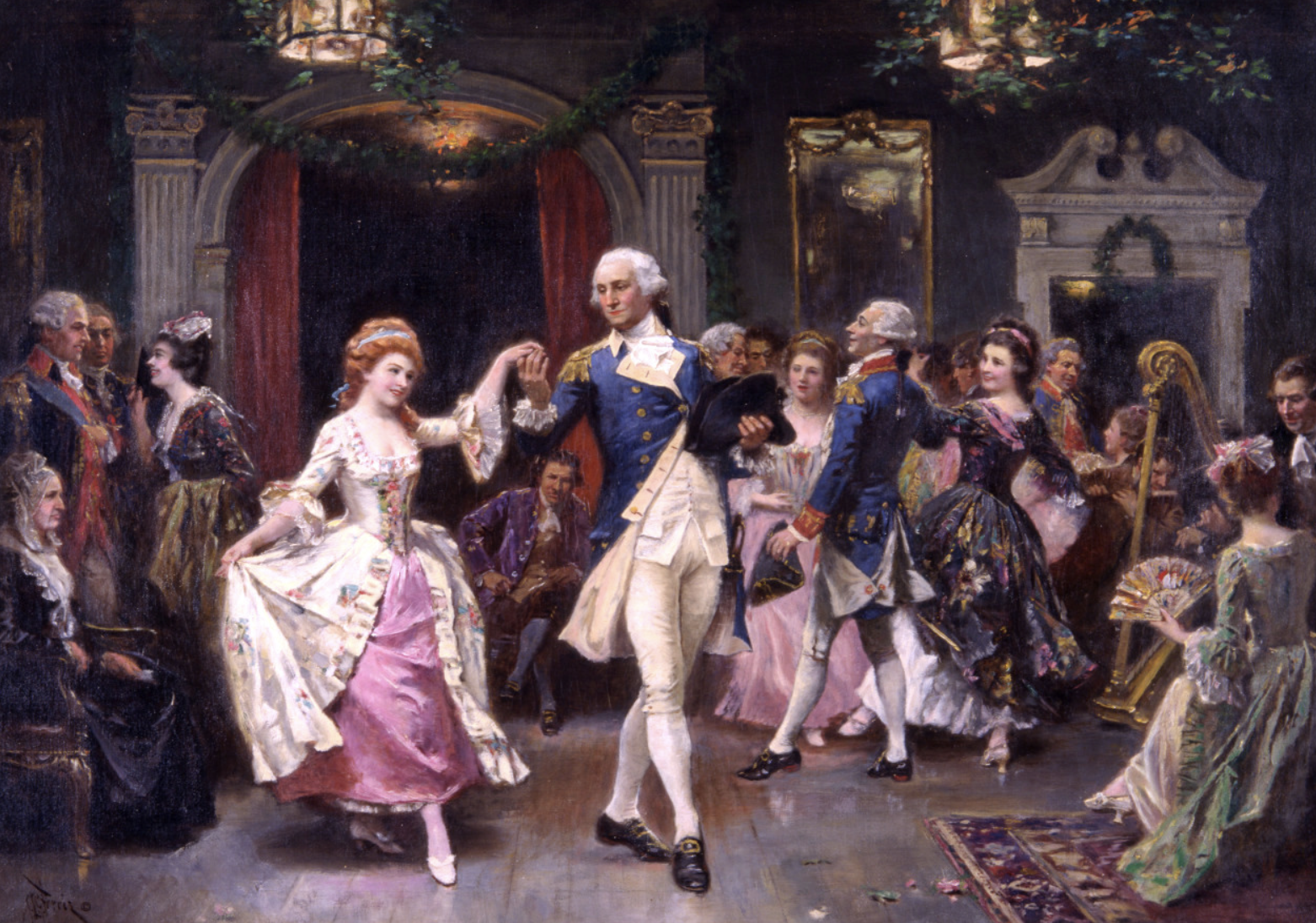
While I was in Lourdes, I read something very funny online by some folks who confuse transitory pastoral advice with immutable doctrine and are opposed to social dancing. Their post beautifully illustrates the necessity of examining social and historical contexts before citing religious authorities.
In this case, not only did one authority (an early Archbishop of Baltimore) cited wish to discourage in young people an inordinate love of dancing assembles, he also believed the young should stop going to the theatre, refrain from reading novels, and be more conscious of class distinctions in their dress. Yes, apparently poor Archbishop Ambrose Maréchal (b. 1764 – d. 1828) thought in 1818 that American women had too great a love for clothes, “which is carried to such a pitch that it would be hard to distinguish a cobbler’s daughter from a French countess.”
Hilarious! What, a middle-class French cleric who had lived through the French Revolution and had just missed the Terror by the skin of his teeth objecting to democracy in dress? Say it ain’t so. As for the novels filling American bookshops, I wouldn’t want my teenage daughters reading Pamela, Clarissa, Manon Lescaut or Dangerous Liaisons , but anything by Fanny Burney, who had great influence on both Jane Austen and American letters in general, I would bring home to them myself.
“But, Mama, Archbishop Maréchal says—-.”
“I’m amazed Archbishop Maréchal has any time for novel-reading, given the property disputes and schisms that take up so much of his attention.”
Yes, the career of the poor bishop involved laypeople who wanted more say over the running of their local Church, so not only the French but the American Revolution might have negatively influenced the bishop’s (and other aggrieved bishops’) attitudes.
Incidentally, a handy guide for priests and parents at the time (and off and on from 1559 – 1966) was the Vatican’sIndex Librorum Prohibitorum, which listed books thought dangerous to faith and morals. It did not condemn all novels. As for the theatre, I know rather more about 18th and 19th century novels (which I studied at university) than I do about theatre, but I imagine that there, too, intelligent American Catholic parents could discern what was suitable for themselves and their children.
Even the Catholic reader with a fearful tendency to scrupulosity when it comes to partner dancing will wonder if an antebellum bishop’s dislike of novel-reading, theatre, and lack of class distinction in dress might be, you know, historically conditioned. Since 1818 there have been wonderful Catholic novels, and before and since there have been glorious Catholic plays. Today traditional Catholics are more concerned about modesty in dress (and where to find modest clothes in our increasingly trashy shops) than we are about girls of humble origins looking like ladies of privilege. In fact, we would prefer that they took the Princess of Wales (aka the Countess of Strathern, etc.)and not Nicki Minaj as their sartorial model.
And after pondering the historically-conditioned episcopal opinions on novels, theatre and dress, the reader might begin to wonder if the same is true for ones against “dance assemblies” and even social-dancing-in-general. I think my readers know the answer.
The illustration is called “Victory Ball, 1781” by Jean Leon Gerome Ferris, which belongs to The Virginia Museum of History & Culture.
Leave a Reply