
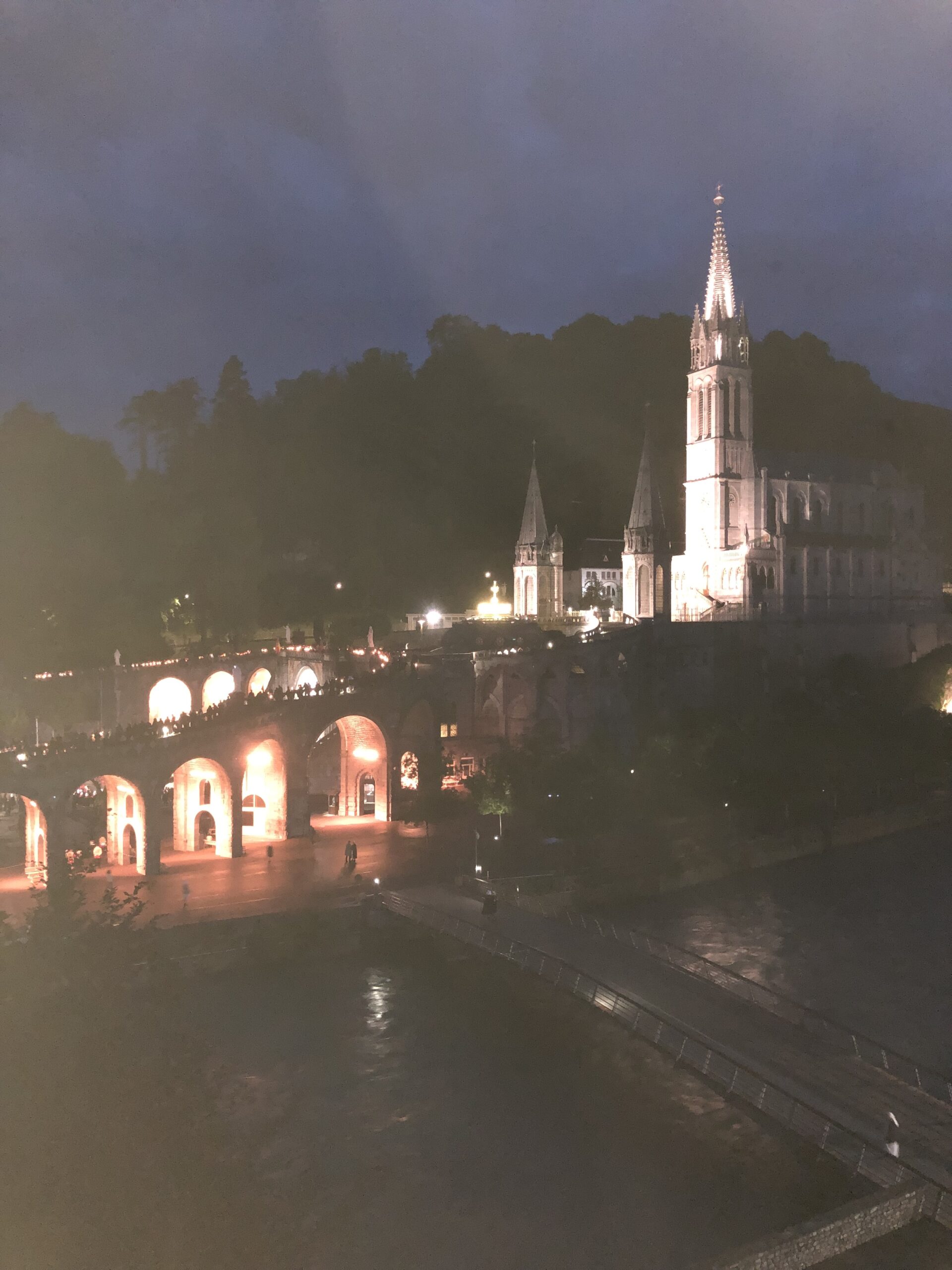
Mr McLean and I returned from Lourdes yesterday, tired from the journey but grateful for the graces received. Some of these—like the heart-stopping beauty of the Sanctuary of Our Lady of Lourdes set against the green foothills of the Pyrenees—were apparent. Others have not yet unfolded. We watch and pray.
We were the guests of the British Association of the Sovereign Military Order of Malta (BASMOM), who met us at the airport, got us and our luggage over the English Channel, chatted to us and fed us, cleaned our rooms, organised the activities, and periodically asked us if we needed anything. Sometimes we set out on our own, getting lost or overtired or stuck, at which times we were helped by Order of Malta volunteers from other nations, including actual Malta.
As Mr McL was clearly an “Assisted Pilgrim” (aka Malade), we stayed in the Accueil Notre-Dame (finished 1996), which is like a large and super-clean hospital without bad smells or sadness. It has wings and terraces, from which can be seen almost all the “Domain”, about 128 acres of land, river, piazzas, bridges and buildings around the Sanctuary of Our Lady of Lourdes and, of course, the Grotto in which Our Lady appeared to St. Bernadette in 1858. The Domain is closed off from the town of Lourdes by the Gates of Saint Joseph, and there are almost no automobiles: just the odd white van now and again. Thus, there is no sound of cars. In the evenings, there are torchlight processions, and very often by day and by night one can hear singing in the piazza in front of the Basilica of the Holy Rosary (the Sanctuary’s “Lower Basilica”), or from the Basilica of the Immaculate Conception (the “Upper Basilica”), or from the little piazza in front of the Grotto.
As we were part of an International Sovereign Military Order of Malta pilgrimage, one of the most striking morning sights from the Accueil’s terraces was the crowd of volunteers flowing from their hotels in the town through the Gates of Saint Joseph towards the Accueil. Although the uniforms changed a little from nation to nation, most of the women wore old-fashioned nurses’ uniforms of short white veils and under-the-knee white dresses, topped with red cardigans and heavy black cloaks emblazoned with the Maltese Cross. (The British ones had black tights and flat black shoes, too.) Most of the men had dark or grey military-like uniforms, either boiler suits (based on tank crews’ coveralls) or dark jackets with red ribbons and badges and dark trousers, plus berets. They all looked very smart and, as SMOM dominated the landscape, the everyday vulgarity and/or shabbiness of contemporary pilgrims’ clothing (like mine, TBH; Mr McL was resplendent in tweed and wool) was barely noticeable.
Of course, the most striking evening sights were the candlelit processions in Rosary Square, the enormous piazza in front of the Sanctuary. Every night hundreds or thousands of people, the old, disabled or sick pushed and pulled in “chariots” (voiturettes bleues), converge there and walk (or ride) around it praying the Rosary, a mix of singing and recitation, while holding candles stuck into paper shades. (Eventually we had our turn, and very distracting it was, as instead of sticking to French or Latin, those leading the prayers switched to Italian, Portuguese, Spanish, German, Polish and something that was very possibly Japanese. A veritable Babel, but that is the current fashion for “International” Catholic events, so I put up with it and enjoyed cudgelling my brain for the correct sequence of words for the Zdrowaś Maryjo and the distinctions between the Italian and Latin versions.)
There was one discordant note in Our Lady of Lourdes’ very own town and, sadly, it involved dancing.
One evening I went out onto the terrace of our wing to look at the candles and listen to the hymns. I could see through the glass doors that some party was taken place, for it was unusually crowded. However, I was not prepared for the noise that crashed against my eardrums:
Y.M.C.A.
It’s fun to stay at the Y.M.C.A.
They have everything for young men to enjoy.
You can hang out with all the boys!
I don’t know what country they were from, but their intentions were obviously good. In the dark Volunteers were dancing, presumably for the most easily entertained Assisted Pilgrims, and of course it was not a properly ordered dance but the arm-shapes and flailing associated with a song its creators apparently insist is not a gay anthem.
“Et in Arcadia ego,” I thought and escaped to the far end of the terrace, where mercifully I could turn my ears away from The Village People and down towards pilgrims singing Ave Maria. However, the Marian peace of the Terrace was most definitely shattered, and when I made my way back to the doors, the Volunteers were dancing to the recorded strains of
Dale a tu cuerpo alegría, Macarena
Que tu cuerpo es pa’ darle alegría y cosa buena
Dale a tu cuerpo alegría, Macarena
Eh, Macarena!
Macarena, as I assume the good-hearted Volunteers of the other pilgrimage group did not know, is about a party-loving young Spanish lady who commits mortal sins with two friends of her boyfriend and dreams of buying designer clothing. Macarena is, in fact, the Anti-Mary. However, her song comes with a well-known and easily remembered dance.
“They were probably the [nationality],” said Mr McLean when I reported the party on the terrace, and I was sad, because I know perfectly well the [nationality] have an amazingly rich and varied folk dance tradition. I am very sure that their Assisted Pilgrims would have been even more entertained had the Volunteers performed one or two of those dances, especially to a flute or a fiddle or an accordion.
UPDATE: If this is real, heads need to roll:
Is Dancing Queen an appropriate song for a General Papal Audience? Thoughts? (Lord, help me to hold my tongue…)
pic.twitter.com/rnSinnJfyx— Raymond Arroyo (@RaymondArroyo) May 6, 2026
BASMOM had its own little end-of-pilgrimage party, but it took place indoors and did not involve songs offensive to pious ears. What little recorded music there was, was accompanied by some spontaneous swing dance moves by two or four Volunteers dancing together, as one might see early on at a wedding reception.
The next day we assisted at a Mass in the Accueil chapel, which–like all the official Masses–was according to the Novus Ordo. (Mr McL and I escaped, with the help of fellow travellers among BASMOM, to the FSSP Mass on Sunday morning, thus missing out on the multilingual NO celebrated by Arthur Cardinal Roche in the 1958 underground bunker Basilica of St. Pius X. ) Afterwards my husband told me that he was taking away my Trad Card and reporting me to our local FSSP priests because not only did I sing along to “Be Not Afraid,” I knew every verse.
Leave a Reply