
Lent being over, I went to a Lindy Hop social this week. There I joined a friend, saw many regulars and met a young lady visiting from Switzerland. She had come to Edinburgh with some friends, but they had gone home and, having a night to herself she decided to go to the local swing-dance event.
As she was in the same age group as the majority of the dancers, I thought that was a very sensible thing to do. It’s much better to go and find fellow fans of a skilled activity in an alcohol-free environment than to sit bored in a hostel or wander the dark streets alone. Of course, it takes a bit of courage–and the hope to find friendly people. It also involves knowing the local language or at least some English.
To my surprise, the visitor said her English was poor. I reflected aloud that she was doing very well with us—coping with my Canadian accent and my friend’s Polish one. My mind then ranged over the other accents I had heard at Lindy that evening: Spanish, North-of-England, South-of-England, American and Hong Kong. The Swiss girl then said that she had the hardest time understanding Scottish people in shops.
I do understand what she meant. After 17 years in Scotland, I can now watch Trainspotting without subtitles; I couldn’t when it came out in 1996. But Trainspotting was set in Edinburgh. The further away north I travel, the harder time I have understanding locals–and, since he is an expert code switcher–Mr McLean. (I mind the time an elderly lady approached us in Aberdeen, and the two Scots chatted happily and endlessly away in Doric. Ah wis fair scunnert.)
On the other hand, it is a pity that Scots get othered in their own country, and one of my pet peeves is influencers’ habit of posting to social media photographs of Edinburgh with any actual Edinburgher–save the occasional piper–cut out. That said, occasionally tourists loudly admire Mr and Mrs McLean’s tweedy Sunday best and ask if they may take our photograph. And perhaps these travellers also ask themselves, “Who built these wonderful buildings? And who lived in them? And who lives in them now?” and make the time and effort to find out.
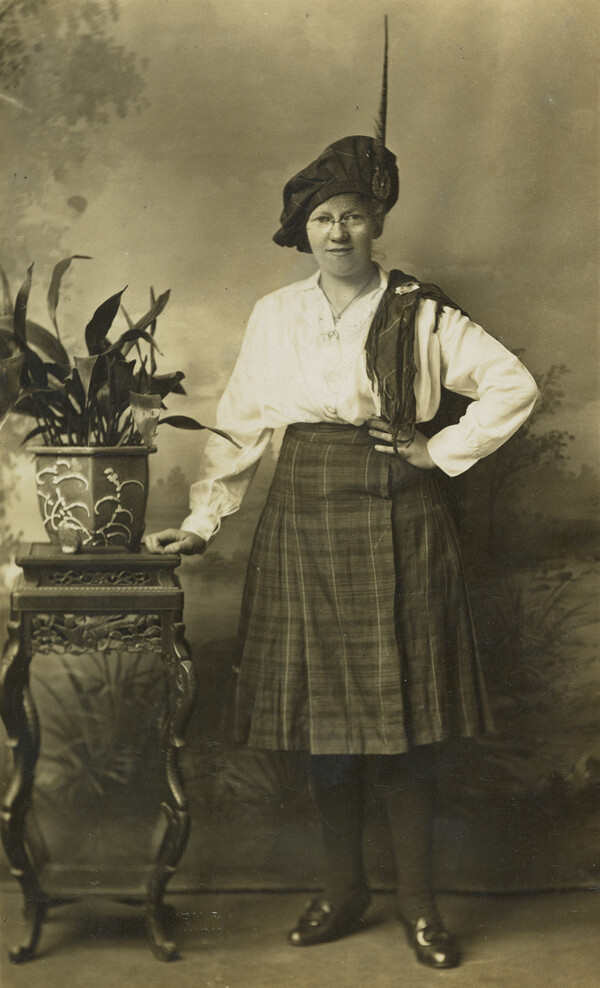
Swing night coincided with a nasty online squabble about some photographs of the new Commonwealth Games official Scottish uniforms. Some commentators feel that the models do not represent the 4.23 million ethnic Scots who still live in the country. Others are more disturbed by the uniforms themselves, which they say look like cartoonish versions of Scottish national dress, or like something dragged out of a tartan tat shop on Edinburgh’s Princes Street. Still others focus on the ludicrousness of representing female athletes with a miniskirt, a pair of stilettos, and a sporran-based handbag. Nobody else seems to have mentioned it, but I can’t imagine a male athlete being able to compete with a plaid hanging down his back.
As the battle rages over the internet and in the newspapers, I am reminded of the “My culture is not a costume” reminders on campuses (including Edinburgh Uni) at Halloween. Part of the anger is that the designer seems to have turned the national dress into a costume. (And then again, part of it is that the women’s uniform is a sexualised nonsense, and another part of it is resistance to the poor models.) And I am also reminded of Canadians and Americans, usually of Scottish descent, worrying about wearing/appropriating the “wrong” clan tartan. This is, in fact, something actual Scots-in-Scotland don’t worry about (with one exception I’ll mention anon). But it would seem that certain kinds of cultural appropriation are indeed a thorny subject here.
Perhaps some inkling of the scandal-du-jour had reached my Polish friend’s eyeballs, for he asked me what I thought of non-Scots wearing Scottish national dress. Having heard and read quite a lot about this, I said I thought it was absolutely fine as long as the national dress was worn correctly.
I could have added, “When in Scotland, do as the Scots do.” Thus, if a non-Scot resident in Scotland is going to a formal event, like a wedding, he should wear national DAY dress or national EVENING dress, but not a weird mix of both. If he is going to an informal event, like a ceilidh or the rugby, he should look at recent photos of ceilidh or sporting crowds. For example, the current fashion for men at ceilidhs (if they care to wear tartan at all) seems to be kilt + T-shirt + socks + running shoes. Meanwhile, national dress should either be rented or bought made-to-measure but NEVER, EVER purchased cheap from a tartan tat shop on Prince Street or the Royal Mile. If it’s cheap, it’s not Scottish. And …

Also, there seems to be a hatred of white kilt hose (i.e. knee socks) on men.
As for women, nobody in Scotland thinks twice about any woman from anywhere wearing tartan–any tartan–but with two cautions. 1. Tartan skirts are, worldwide, very often the dress of schoolgirls. If you wear the wrong one, you will either look like you’ve stolen someone’s school uniform or (if the skirt is short) trying for a “sexy schoolgirl” look, which, if intentional, is disgusting. 2. If you’re wearing “official dress,” get it absolutely right.
Formal dress for women in Edinburgh is really just a formal dress with–if the woman feels like it–a sash pinned over it. The only time I’ve ever seen a lot of women in tartan together was at a Clan MacLean function–£300+ “hostess skirts” everywhere–where Mr McL and I were mildly reproved for wearing Hunting MacLean instead of Dress MacLean. I hope my husband was at least wearing the right jacket.
UPDATE: Mr McLean has reminded me that one can purchase used made-in-Scotland (because, remember, if it’s not actually Scottish…) elements of national dress in shops like Edinburgh’s Armstrong’s.
Leave a Reply